
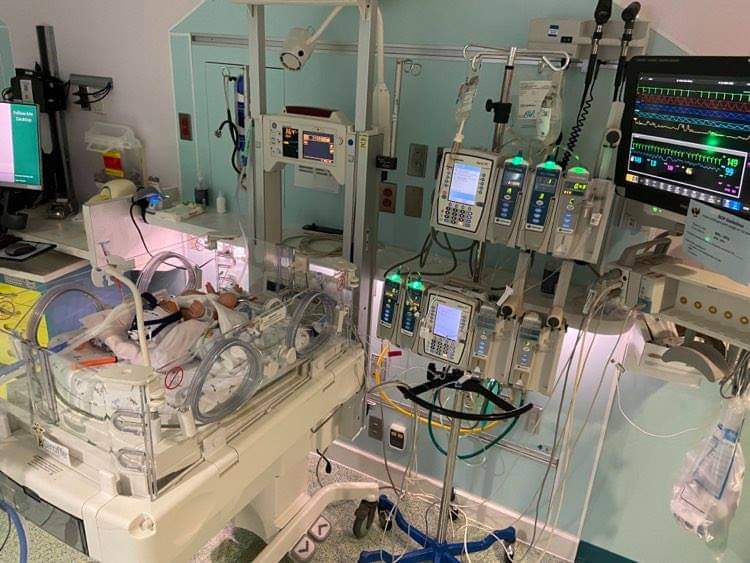
When my experience in motherhood began in the NICU, I learned a whole new (to me) dimension of active trauma, and the whiplash sensation of both sitting with the trauma, the guilt borne of wondering what I might have done differently to have achieved a different outcome for my child, and whether I had the capacity and strength to persevere through the trials that I was facing. Those were the longest 112 days of my life, and during many of them, I didn’t know if my child would ever come home with me – there were too many unknowns, too many variables. At the time, I didn’t have the capacity to grieve what might have been; all of my spoons were funneled into being there for my son, to care for him in whatever small way I could. To learn from his team, and to take up the mantle of medical mom, and my real-life crash course in nursing.
Four years later, it seems like a completely different life. When I look at my son, I barely see that tiny, sick baby in him. Instead, I see this sweet, happy guy who is just in love with life and living every moment to its fullest. He feels everything so intensely and expresses himself in his own way; he doesn’t have words but he communicates with me just as well. After many diagnoses and interventions, the one that is ever-present in day-to-day life is autism spectrum disorder (ASD.) My son is very sensitive, and is constantly sensory seeking. He needs near constant sensory input, sometimes from multiple sources, to remain regulated.
Recognizing the grief
As he grows and develops and achieves milestones on his own time, I have grown with him. It has taken nearly this long to make space to fully process the experience at the start of his life, and to hold space for the grief over all the loss, pain and suffering that transpired during that pivotal time in our life. It feels like I have been moving through life on autopilot for myself; meeting my needs insofar as is necessary in order to ensure I am meeting his needs. Now though, when he is stable, well, and thriving, I’ve begun to recognize the impact the experience had on my nervous system, and how I have come to benefit from the sensory input my son needs to become regulated again.
Coming to understand the mind-body connection

It is easy for me to recognize overwhelm and dysregulation in my son; it often is made manifest with a meltdown or behavioral outburst. For myself, it is not so obvious. I had a habit of internalizing, of pushing it down and ignoring it. But in caring for my child, providing him with joint compressions, brushing, pressure input at various points on his body, I came to realize that these moments of physical contact and input were helping to alleviate my stress too; they were releasing the pent-up anxiety, and helping me to become regulated again.
After becoming a part of LIGHT Movement, I learned about somatic therapy, about the polyvagal theory, and about self-regulation in the form of mindfulness exercises, yoga, and physical wellness in working through grief and loss. And when I tell you I had a eureka moment of epic proportions! It was the missing piece; it connected the dots. My sensory seeking child, with a love for vestibular movement and sensory input, had been teaching me to self-regulate his entire life and I didn’t even realize it.
