
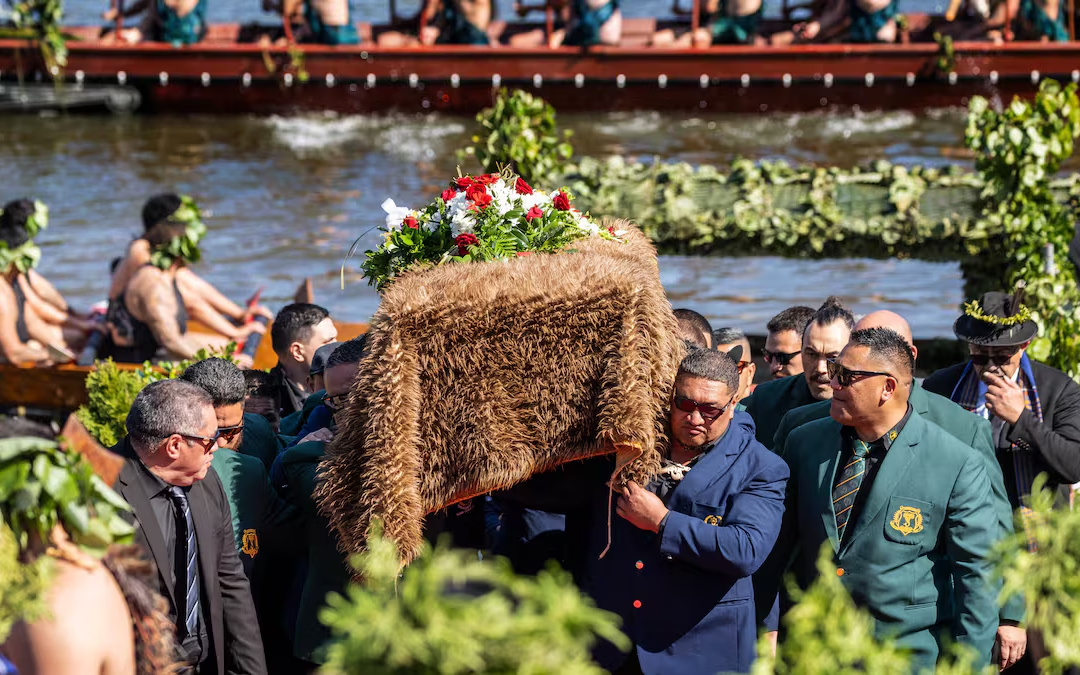
In late 2025, my junior year of college, I had the privilege of living in Aotearoa, New Zealand, for four months. While there, I learned about Māori culture, and since starting at LIGHT, I’ve had the opportunity to research Māori grieving practices. I also interviewed my friend Phoebe Pepper (Te Ātiawa), who is Māori. I really enjoyed learning about the way Māori grieve, and am excited to share some things that really stuck with me.
Grief shared openly
What struck me most about the Māori view of grieving was not any single practice, but a broader philosophy: grief is something to be expressed, not managed, and most importantly never faced in isolation. When someone dies, the whānau (family or extended family) immediately begin preparing for the Tangihanga (tah-ngee-HAH-ngah). The word itself carries the practice’s meaning: the word tangi itself means to cry or weep. While many Western funeral traditions implicitly ask mourners to compose themselves, Tangihanga asks the opposite: it encourages people to express what they are feeling to the fullest. Letting out as many roimata (tears) as possible is a good thing. Grief here is not something to navigate with restraint; it is something to feel fully and move through with your people. As Phoebe put it plainly: “It’s huge… no one grieves alone.” That sentence has stayed with me.
The Importance of Community
Community is critical to the way Māori grieve. Extended family, friends, and others who knew the deceased support the grieving whānau (FAH-noh) materially, offering kai (food) and money. The financial support helps cover the Tangihanga and other expenses after a death; food sustains the whānau and is shared during the Tangihanga.
Historically, a Tangihanga could last for weeks, but today it is often condensed to three days, largely due to societal changes in Aotearoa shaped by colonialism. It is no longer possible for many people to take as much time off from work, and travel as well as other issues can also create barriers. During a Tangihanga, those outside the immediate whānau often visit for a single day, sitting with the family, sharing memories, weeping together, and closing the day by sharing a meal and karakia, a Māori prayer or blessing. It is grief held collectively by a community rather than carried alone by a few.
Never left alone
One element that stood out to me as an outsider is that the deceased is never left alone. Before the Tangihanga, the body is bathed and dressed in traditional Māori clothing, then taken to a Marae, a traditional Māori meeting house. When they arrive, the spirit of the deceased and the whānau are greeted with a pōwhiri, a Māori welcome ceremony. Haka is also often performed at the tangihanga. The spirit of the deceased is understood to still be present, so members of the whānau keep company with the person who has died, including through the night.
The body is usually in an open casket and is generally not left alone from the moment the person dies. Only at the close of the Tangihanga does the whānau formally signal that the spirit no longer needs to linger, freeing it to continue its journey. Once this has happened, the spirit is believed to travel north, through the top of the North Island of Aotearoa, toward Hawaiki, the ancestral Polynesian homeland. The physical body is laid to rest in an Urupā, a Māori burial ground and a year later, a headstone is unveiled.
Tangihanga in the current day
It would be inaccurate to present this practice as universally observed in its full traditional form today. Phoebe was clear that because of colonization, the contemporary reality is more varied: not every Māori family has access to an urupā, and not every death is marked by a full traditional Tangihanga. The practice requires significant coordination, people, time, and resources, which can be difficult for many Māori today, who face barriers such as distance, travel, and competing obligations. Some families choose cremation over burial, which is not looked down upon. Others adapt the spirit of the practice to circumstances that don’t allow for its full traditional form. Still, the core values remain.
What Tangihanga offers the rest of us
Sitting with this research, I found myself returning to how differently grief is often handled in Western contexts, and specifically in the United States, where bereavement leave is frequently measured in days, and there is a quiet but persistent expectation for people to return to “normal” as soon as possible. In reality, grief doesn’t work that way.
That contrast feels especially relevant given Aotearoa’s own colonial history under English rule, where the imported cultural ideal was, and to some extent remains, what Phoebe described as “stiff-upper-lip” restraint. Tangihana doesn’t work this way. Instead, it offers a model in which grief is not privately regulated but actively shared by a whole community.
What I took away from the way Māori grieve is that grief doesn’t need to be navigated alone nor held in or restrained. A community showing up across days can offer something many Western cultures have lost sight of. In American society, where an estimated 10 to 30 percent of those seeking mental health services report unresolved grief as a contributing issue, we might do well to be more open with the grief we feel. To share our grief. To come together in grief and be there for each other. We would do well to remember Phoebe’s words: “No one grieves alone.”