
Last May, I experienced my second miscarriage.
I wish I could say that because I had experienced pregnancy loss before, I knew what to expect. I wish I could say it hurt less the second time because I had already been through it. But grief doesn’t really work that way.
It doesn’t get easier.
Each loss is its own loss. Each baby is their own baby. Each experience leaves its own space in your heart, and no amount of previous grief can truly prepare you for the next one.
When I lost my baby in May, I knew I needed to find something that could help me move through the grief. I didn’t necessarily know what I was looking for. I just knew I couldn’t stay in that darkness forever.
A few months before my miscarriage, in February, I had bought a camera. I had dreams of learning photography, but I barely touched it. I didn’t know what I was doing. Aperture, shutter speed, ISO—there were so many words and settings that felt completely foreign to me. I had a camera, but I didn’t know how to use it.
After my miscarriage, something physically, emotionally, mentally changed. So, I picked up my camera.
At first, I think I threw myself into photography because I needed somewhere else for my mind to go. I wanted something to focus on other than the fact that I had lost my baby.
I watched tutorial videos. I read Facebook groups for advice. I practiced. I tried to understand the endless screens of settings on my camera. I just wanted to know how to make my camera do what I wanted it to do.
Honestly, I became frustrated and felt discouraged.
I wanted to learn faster. I wanted to understand everything immediately. I would get angry with myself when I couldn’t figure something out. But eventually, I had to stop and remember why I had picked up the camera in the first place. It wasn’t because I needed to become a perfect photographer. It was because I needed a way to express myself. I wanted to learn how to show people the way I see the world.
Photography provided me with a way to take something that was happening inside of me and put it somewhere outside of myself. There were feelings I couldn’t explain with words. There were days when I cried so hard that I couldn’t catch my breath. There were moments when the grief felt like it was taking over my entire body.
And I still had two little children at home who needed their mom.
My children are four and two. They needed breakfast, lunch, dinner, and snacks, of course. They needed hugs. They needed someone to play with them, comfort them, and help them through their own little worlds.
So I kept going.
Not because I wasn’t grieving.
Because I was.
I just needed to find a way to carry my grief while still living my life. This is where photography became more than just a hobby for me. It became a way of connecting with myself and with the world around me. There is something very grounding about looking through a camera.
I have to slow down.
I have to notice what is around me.
I have to look at light, colors, shapes, movement, and small details that I might otherwise walk right past.
Sometimes I have to physically move my body to find the angle I want. I might crouch down, stand up, walk closer, step back, or turn toward something I hadn’t noticed before. And for a moment, my attention isn’t completely consumed by the thoughts inside my head. I’m here. I’m looking. I’m breathing. I’m noticing.
I’m still for a moment.
This is one of the ways I have come to understand photography as a somatic tool.
Somatic tools can help us reconnect with our bodies and the present moment. Grief isn’t only something we think about. We can feel it physically. It can show up as heaviness in our chest, tears, exhaustion, tension, restlessness, or that feeling of not being able to catch our breath.
Photography didn’t take my grief away.
Instead, it gave my body somewhere to go with it.
I could take a walk with my camera. I could notice the sunlight. I could focus on a flower moving in the wind. I could take a deep breath while trying to capture the perfect photograph. I could use my hands, my eyes, my body, and my creativity instead of sitting completely still inside my sadness.
And then there were the flowers.
My husband was beside me through every step of this process. He bought different kinds of flowers for us to plant, but especially sunflowers because they are my absolute favorite.
We planted them right outside our door. My children helped me water them every day. Watching those flowers grow became something much bigger than gardening. It became a reminder that something beautiful could still grow even after something terrible happened.
I remember being so excited for the flowers to bloom because I knew I was going to photograph them. I wanted to capture every part of them—the beginning, the growth, the tiny details, and eventually the full bloom.
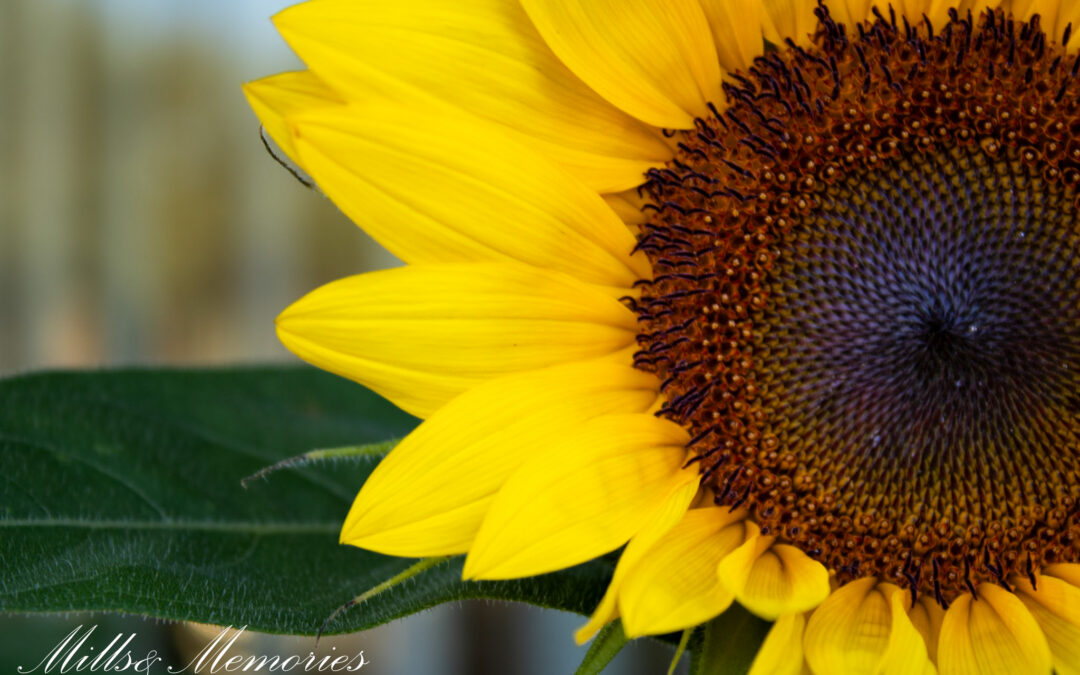
The sunflowers became especially meaningful to me. I eventually created my own little photography business, and I built my logo around sunflowers. To someone else, it might just look like a picture of a sunflower. But to me, it is so much more than that.
It is a reminder of my baby.
It is a reminder of the love that existed.
Even though I didn’t get to bring my baby home.
It is a reminder that something can grow from something painful. In some way, I like to think that my baby grew into something different. Not the life I imagined. Not the ending I wanted. But something beautiful that I can carry with me.
Photography taught me that grief doesn’t always need to be expressed through words. Sometimes it can be expressed through light. Through flowers. Through movement. Through color. Through the things we notice when we slow down enough to really look.
I don’t think photography healed my grief. I don’t think grief is something we simply “heal” from and leave behind. Instead, I think I learned another way to carry it. I learned that I can miss my baby and still laugh with my children. I can have days where I am angry and days where I feel incredibly grateful. I can cry and then pick up my camera. I can feel broken and still create something beautiful.
And maybe that’s what grief has taught me most.
We don’t have to choose between grieving and living. We can do both. Sometimes healing looks like talking. Sometimes it looks like crying. Sometimes it looks like planting flowers with your children. And sometimes, it looks like picking up a camera and searching for something beautiful through the lens.
For me, grief changed the way I see the world.
Photography helped me learn how to look again.
A Somatic Photography Exercise
If you are carrying grief, or simply having a difficult day, try this: Find something that is one of your absolute favorite things. It could be a favorite color, a flower, a tree, a place, your child’s little hand, the sunlight coming through a window, or anything that brings you even a tiny bit of comfort.
Take a moment to really look at it.
Before you take the picture, slow down. Take a breath. Notice the colors, the shapes, the texture, the light, and the little details you might normally overlook.
Then take your picture.
Don’t worry about getting the perfect photograph. Instead, take a moment to admire the small, hidden beauty in the thing you chose.
Look closely.
What did you notice that you might have missed before?
Let yourself be present with it for a moment.
You don’t have to make your grief disappear. You don’t have to force yourself to feel happy. You are simply giving yourself permission to notice that even while carrying something painful, there can still be small moments of beauty around you.
For me, that beauty became sunflowers.
Maybe for you, it will be something completely different.
And that’s okay.
Sometimes we don’t need to look for something big. Sometimes we just need to slow down long enough to see the little things that were already there.